
$A$ railway engine whistling at a constant frequency moves with a constant speed. It goes past a stationary observer standing beside the railway track. The frequency $(n)$ of the sound heard by the observer is plotted against time $(t).$ Which of the following best represents the resulting curve?
- A
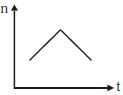
- B
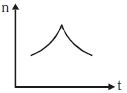
- C
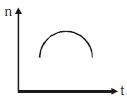
- D
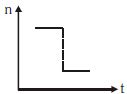
Explore More
Similar Questions
$A$ siren emitting sound of frequency $800 \; Hz$ is going away from a static listener with a speed of $30 \; m/s$. The frequency of the sound heard by the listener is... $Hz$ (take velocity of sound as $330 \; m/s$).
MediumAIIMS 2002
View Solution$A$ vehicle sounding a whistle of frequency $256 \,Hz$ is moving on a straight road towards a hill with a velocity of $10 \,ms^{-1}$. The number of beats per second observed by a person travelling in the vehicle is (velocity of sound $= 330 \,ms^{-1}$).
DifficultAP EAMCET 2005
View SolutionAn observer is standing $500 \,m$ away from a vertical hill. Starting between the observer and the hill, a police van sounding a siren of frequency $1000 \,Hz$ moves towards the hill with a uniform speed. If the frequency of the sound heard directly from the siren is $970 \,Hz$, the frequency of the sound heard after reflection from the hill (in $Hz$) is about, (velocity of sound $= 330 \,m/s$):
DifficultTS EAMCET 2006
View Solution$A$ car sounding a horn of frequency $1000 \text{ Hz}$ passes an observer. The ratio of frequencies noted by the observer before and after the car passes is $11:9$. If the speed of sound is $V$,what is the speed of the car?
With what speed should a sound source move towards an observer so that the observer hears half the original frequency $(v)$?
Easy
View SolutionVedclass Products
For Students
Vedclass Test Series
Mock tests in real JEE/NEET style with performance analysis. 5-day free trial.
Start Free TrialFor Teachers
Exam Paper Generator
Generate Set A/B/C/D exam papers from 7.5L+ questions in 2 minutes. 3 chapters free.
Try FreeFor Institutes
Online Exam Module
Live online exams with unlimited students, 360° analytics & white-label branding.
See Demo